
The Neal Deal
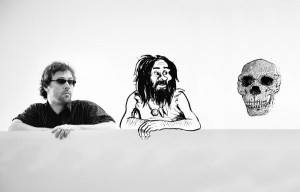
The Sanctuary, the title of New York cartoonist Nathan Neal’s new graphic novel, evokes images of a place of refuge or a sacred space devoted to worshiping the divine. It makes sense, given that the book imagines a world with beautiful cave paintings created in a cavern sometimes used for religious rituals. But this title was not Neal’s first choice.
“I wanted the title to just be an image of a bison,” Neal said.
Unfortunately, book retailers must have an English name under which to file their products. And thus, The Sanctuary was titled.
It is one of the few compromises in a unique and refreshing graphic novel. The book, drawn in stark black and white strokes, tells the story of a prehistoric tribe whose cave paintings are reminiscent of those found in the caves of France. The first thing the reader will notice is that none of the dialogue in the book is in English. Neal has taken the trouble to create his own language, which is spelled out phonetically for the English reader.
“I couldn’t have them walking around speaking English,” Neal said. “It would destroy the credibility.”
Neal created the language, which has a crude grammatical structure and about 300 words, based on the experience of living in Mexico and speaking almost no Spanish.
“I memorized a few hundred words and a few conjugations, and that was enough for me to get through,” Neal said. “That’s what I based the language on — that sort of pigeon Spanish.”
The effect is immediately intriguing and a bit daunting. “You basically have to read it twice,” Neal said. “Once to just get your bearings, and then the next time you read it, you can sort of understand it better and digest it.”
Fellow cartoonist Dave Sim compares the book to a pearl trapped in an oyster. In the introduction to The Sanctuary, Sim reminds the reader that only a fool would throw away a beautiful prize just because he couldn’t get the mollusk open right away.
“Look at it as a better value for the money than you expected. The Sanctuary will reward you a thousand fold,” Sim writes.
While the language and the ways of the characters in the book will be unfamiliar to readers, the motives that drive them are as old and familiar as the sun. Neal sees the ancient setting as a way to get at the core of what it means to be human—in any era.
“It is a chance for me to examine human behavior on a more universal level,” Neal said. “Sex, power, revenge, the primal stuff, is underneath everything that we do. There’s more covering over what we do now. With the cavemen, I can strip everything away and get right down to it.”
The story centers on Jani, the tribe cave painter, and explores the relationship between art and power. Neal can identify with the oft-misunderstood artist he created.
“He’s forced to use his artistic abilities to perform a functional sort of thing for the society in order to survive, and he has to do his own stuff in private,” Neal said. “When he does his own stuff in public, it kind of backfires and doesn’t get the response he intended. I think that’s the case a lot of times with my work. It’s weird because it’s cavemen, but my life seems sort of underneath the whole thing.”
The story also considers the dynamic between women and men, something Neal did not initially intend to be a major storyline. According to Neal, the women “weren’t such a dominant force when I started writing the book, but I just kind of fell in love with them, and I wanted to draw them more. They kept having a stronger role until basically, they just take over.”
Neal has been writing and illustrating since he was a child. After attending art school, he began working for MAD Magazine writing “Spy vs. Spy Junior” and “Willy Nilly,” a strip in which a boy perishes by each end panel. He later worked for Nickelodeon Magazine and currently writes a one-page comic for the Spongebob Squarepants comic book.
Neal finds the medium of comics highly musical. “There’s a definite rhythm and beat when you’re making it,” Neal said. “It’s divided up. You can’t just plunk down things that are happening.”
He sees reading and appreciating comics as a lost art. In the 1950s, comic books were available in every drug or dime store, and children grew up accustomed to interpreting words and graphics simultaneously. Now, Neal says, even very intelligent people often find comics, “a brain scrambler.”
A second graphic novel currently occupies the Brooklyn artist’s time. This one takes place in a more recent era of yesteryear, 1999. Given that Publisher’s Weekly calls Neal “an artist to watch,” if we are lucky it will be as compelling, provocative, and creative as The Sanctuary.
Interested in seeing more of Nathan’s work? Check out www.nateneal.com.
Video and photos by Daniel Pagel.


